This is the third and final post in our series on Australian trading conditions. So far we’ve looked at the cash flow squeeze and rising insolvencies, and at Australia’s stalled productivity.
This week we step back to the wider economy and the state of public finances.
Beyond your own balance sheet, government debt shapes interest rates, inflation and the Australian dollar, which all feed into your costs, your customers’ spending and your borrowing.
What the data shows
Federal government debt reached $981 billion at 30 September 2026 and is expected to pass $1 trillion in the coming financial year.
The federal budget was in deficit every year from FY2008 to FY2022, recorded a reduction in debt in FY2023, and has returned to deficit since. The pandemic made things considerably worse, adding around $350 billion to net liabilities across FY2020 to FY2022.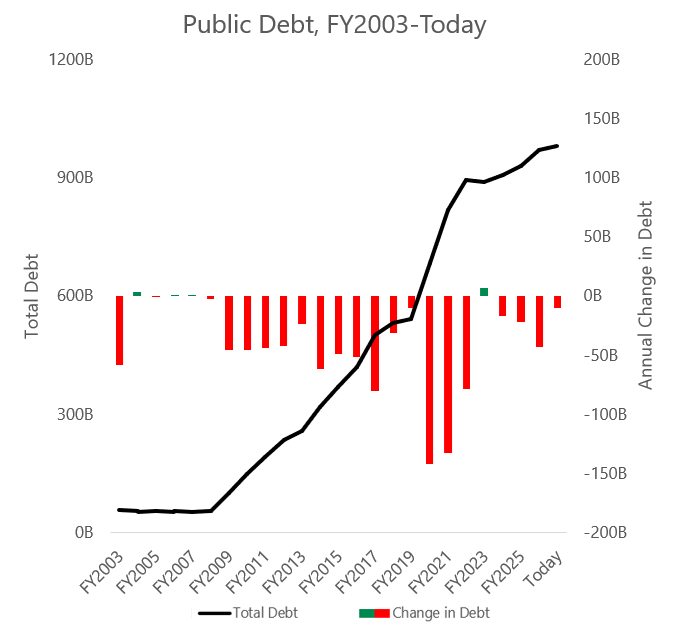
ABOVE: Public debt skyrocketing due to continued deficits. Source: Australian Office of Financial Management.
Spending has stayed elevated since stimulus ended. Government spending reached 28.7% of GDP in FY2026, the highest on record, compared with an average of 24.0% over the past 80 years.
The rising cost of carrying the debt
Debt is now more expensive to service than it has ever been.
Annual interest payments are about $25 billion and are forecast to rise to about $40 billion by FY2030. To put that in perspective, $40 billion is roughly the size of the entire debt increase/deficit in FY2026.
A growing slice of the budget will go to interest rather than to services or investment, which limits what governments can do.
How it flows through to businesses and consumers
This environment has contributed to higher inflation and rising interest rates, creating an unfavourable backdrop for both businesses and consumers:
-
Inflation. Inflation has run at around 4% since the pandemic, above the RBA’s 2–3% target. That pushes up your costs and eats into your customers’ spending power.
-
Interest rates. Higher rates raise the cost of business borrowing and leave households with less to spend.
-
The Australian dollar. The currency has weakened to around US70 cents, from highs near parity in the early 2010s. That makes imported inputs and equipment more expensive, although it can help exporters.
What it means for your business
Regardless of where you sit politically, the practical points are the same:
-
The economy matters. Interest rates, inflation and the exchange rate are all relevant to your planning, not just background noise.
-
Policy could change. High debt could eventually lead to new taxes, spending cuts or other changes that affect your business or your customers.
-
Planning beats reacting. You need to prepare to take advantage of opportunities and protect yourself against these risks.
How to prepare
While no one can predict policy, there are sensible steps that put you in a stronger position whatever happens:
-
Stress-test your numbers. Check how your business would cope with higher interest costs, higher input prices or softer customer demand.
-
Review your debt. Look at your borrowing structure and talk to your lender or adviser about whether fixed rates or other options make sense for you.
-
Understand your currency exposure. If you import, export or buy supplies priced in foreign currency, know how exchange-rate movements affect your margins and consider whether hedging is worthwhile.
-
Build flexibility into your cost base. Where you can, favour arrangements that can scale up or down with demand rather than locking in fixed costs.
-
Stay informed. Keep an eye on budget announcements and RBA decisions, and speak with your accountant about how changes could affect you.
The bottom line
Government debt can feel remote from day-to-day trading, but its effects reach your business through interest rates, inflation and the dollar. Owners who understand those links, plan for a range of outcomes and stay flexible will be best positioned to ride out the risks and make the most of the opportunities.
Want to understand how the economic outlook affects your business plans? Get in touch with the JPAbusiness team to talk through your options.
This article is general information only and does not constitute financial, legal or tax advice. Consider speaking with your accountant, financial adviser or business adviser about your specific circumstances.