
This is the second post in our three-part series on Australian trading conditions.
Last week we looked at the cash flow squeeze and the surge in insolvencies.
This week we turn to one of the less visible causes of the pressure: productivity, or the amount of value each worker produces in an hour.
It’s the long-term engine of wages, profits and living standards, and Australia’s has stalled.
What the data shows
Australian workers produce only about 14% more per hour than they did 20 years ago, and roughly the same as they did in 2019.
Other major economies have done far better over the same period. Output per hour has grown by about 41% in the US and about 60% in China (the latest Chinese figures available run to FY2023). Australia has fallen well behind our major trading partners.
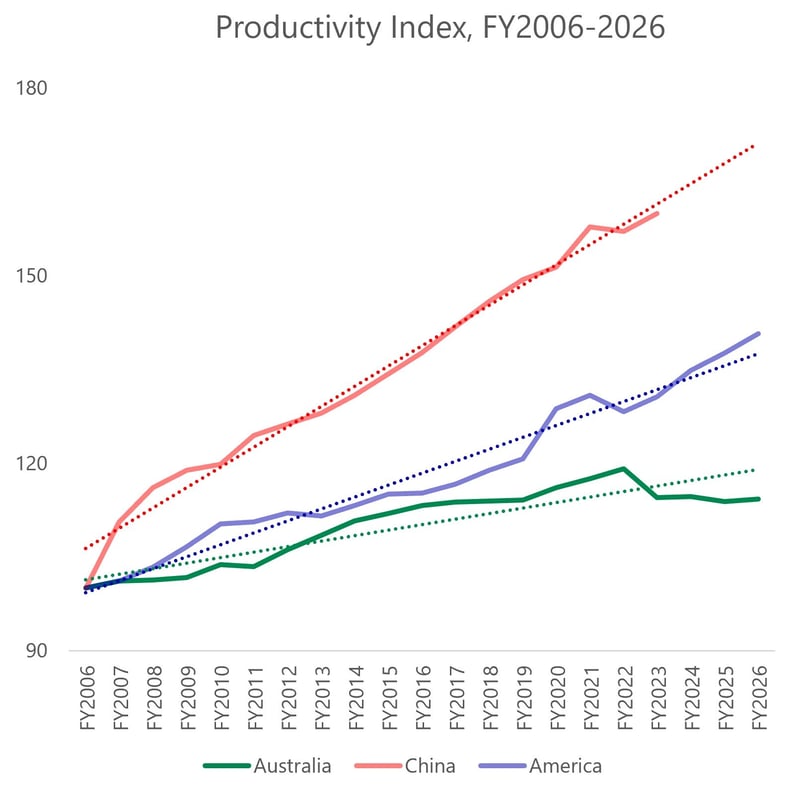
ABOVE: Australia’s productivity is lower than our major trading partners. Graph shows productivity in Australia and two of our major trading partners, China and the US,
indexed to productivity 20 years ago i.e. productivity at FY2006 = 100, productivity of 101 = 1% higher than 2006.
Sources: Australian Bureau of Statistics; US Bureau of Labor Statistics; National Bureau of Statistics of China; RBA.
Why it’s happening
Several forces are behind the slowdown:
-
The end of the mining boom. Business investment has fallen to around 12% of GDP, compared with an average of about 15%, and the economic boost the mining boom provided has faded.
-
Weak investment more broadly. Outside mining, businesses are investing less in equipment, systems and technology.
-
Red tape and limited competition. Regulation, licensing requirements, weaker competition and slow technology adoption all hold back productivity growth.
-
A shift in where jobs are growing. Employment is increasing fastest in sectors such as health and care, where productivity growth is naturally harder to achieve.
What it means for your business
-
Wages and input costs are getting more expensive, but workers aren’t producing more. That gap eats directly into profit.
-
Costs are growing faster than output. This squeezes margins and forces price increases, which is a hard message to deliver to customers who are already cutting back.
-
Better technology and education aren’t being turned into output. The potential gains are there, but they aren’t yet showing up in the numbers.
How the winners will respond
The businesses most likely to thrive will not simply hire more people. Adding headcount to a business with flat productivity just adds cost. Instead, they will get more out of the team they already have, using AI, software and other tools.
There is a clear opening here for smaller operators. Only about 11% of small businesses currently use AI, compared with 35% of large businesses. Small businesses that move early can narrow that gap and compete more effectively with larger rivals.
A practical place to start is to list the repetitive tasks that consume your team’s week, such as quoting, invoicing, scheduling, customer follow-up and reporting. Then ask which could be automated or sped up with tools that already exist. Even modest gains, repeated across a whole team, add up quickly.
The bottom line
You can’t fix national productivity on your own, but you can fix it inside your own business. In an economy where costs keep rising and output per worker isn’t, lifting what each person produces is one of the most powerful ways to protect your margins.
Not sure where to start with productivity or technology? Contact the JPAbusiness team for a practical conversation about where the biggest gains might be in your business.
DISCLAIMER: This article is general information only and does not constitute financial, legal or tax advice. Consider speaking with your accountant or a business adviser about your specific circumstances.