This is the first post in a three-part series, published over three weeks.
There’s a feeling among Australian business owners that trading conditions haven’t been this tough since the early-1990s recession. This series looks at what’s happening in the economy right now, how the trends have moved over time and what it all means for your business.
Over the three weeks we’ll cover cash flow and insolvencies (this week), productivity (next week) and government debt (the week after).
We’re starting with cash flow because it’s where the pressure shows up first. Here’s what the numbers show, what’s driving them and how to protect your business.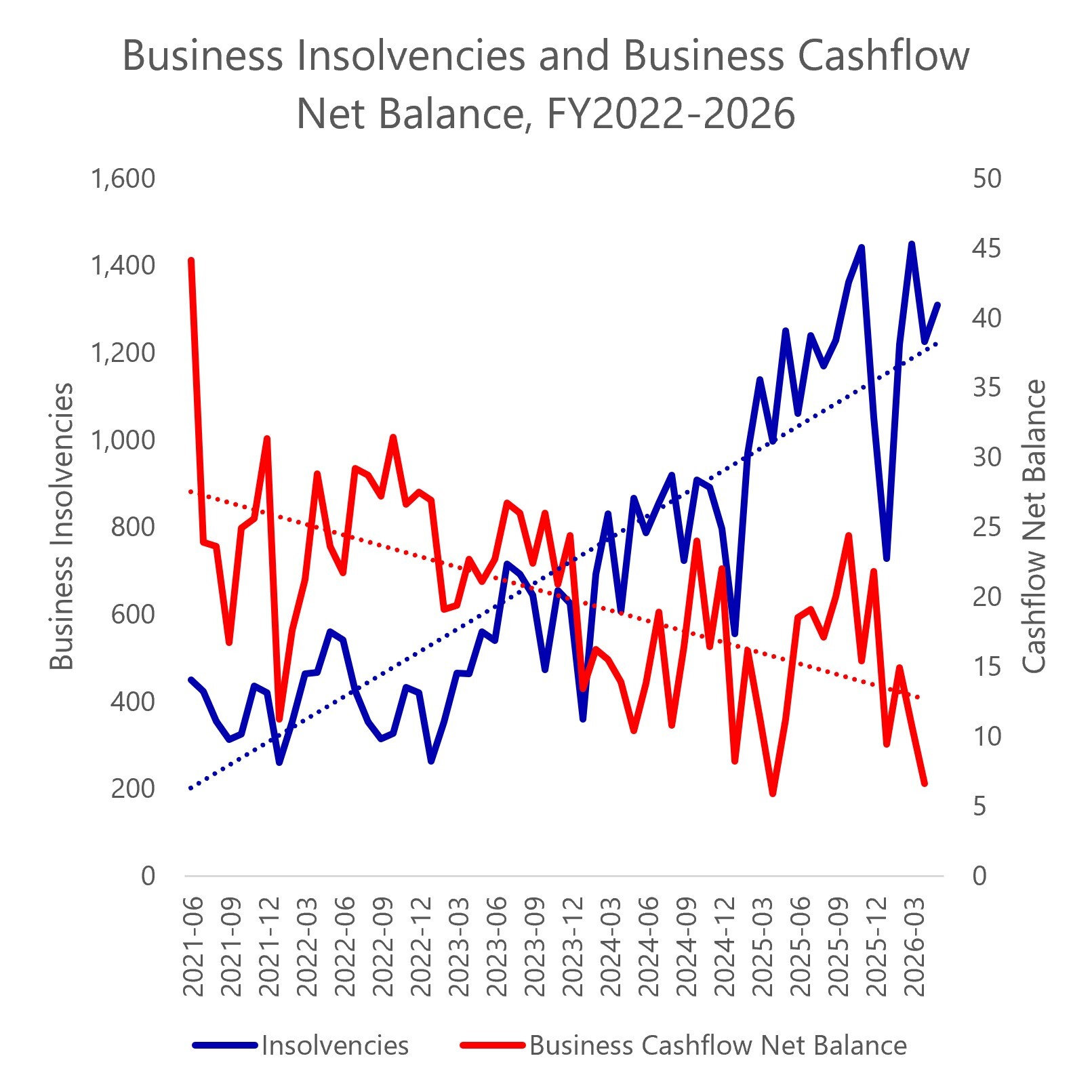
ABOVE: Businesses are experiencing tight cash flows while insolvencies skyrocket. Sources: NAB Business Surveys; Australian Securities and Investments Commission (insolvency data); RBA; ATO.
What the data shows
The number of Australian companies entering insolvency has climbed sharply. According to ASIC data, only 7,942 companies entered insolvency in FY2023, while 14,722 and 14,153 companies entered insolvency in FY2025 and FY2026 respectively. This represents an increase of ~80% in just 2–3 years, and early numbers for FY2027 indicate it could be ~25% higher than FY2026 numbers.
NAB’s business survey shows the pressure from the other direction. It measures cash flow as a net balance, which is the percentage of businesses reporting good cash flow minus the percentage reporting bad. In May 2026 that figure fell to about +5, a five-year low and well below the long-run average of roughly +18. In other words, businesses with good cash flow now barely outnumber those with poor cash flow.
Other NAB measures are weak too. Profitability sits at around -9 and sales margins at around -20, some of the lowest readings since COVID.
Small businesses are hit hardest
More than three-quarters of recent insolvencies have been businesses with fewer than 20 employees. The reason is usually the same one: running out of cash is the most common cause of business failure. A business can be profitable on paper and still fail if the money isn’t in the bank when the bills fall due.
Why it’s happening
Three pressures are landing at once:
-
Weak household spending. Household consumption is about 52% of GDP, compared with a long-run average of around 56%. Customers are spending less, which directly reduces sales.
-
Higher costs and higher interest rates. Input costs have risen and so has the cost of borrowing, squeezing cash flow from both sides.
-
The end of the COVID safety net. Stimulus measures have been wound back, and the ATO has resumed collecting tax debts that built up during the pandemic.
What it means for your business
Working capital is now a top priority and should be tracked as a key KPI, reviewed regularly rather than only when cash feels tight.
Costs also deserve a careful, line-by-line review, with savings made wherever you can do so without harming your ability to serve customers.
How the winners will respond
The businesses most likely to come through this period strongly are doing three things:
-
Planning early for the risk of negative cash flow. If your forecasts point to a shortfall, act before it becomes a crisis. That could mean renegotiating with lenders, suppliers or the ATO, restructuring, or even selling while the business still has value. Talk to your accountant or a business adviser early, because options narrow quickly once cash runs out.
-
Protecting cash and staying open. Tighten debtor collection, negotiate supplier terms and keep a buffer for the unexpected. The simplest way to benefit from this period is to still be trading at the end of it.
-
Taking advantage when weaker competitors exit. As others fall away, customers, skilled staff, suppliers and premises become available to the businesses that are still standing.
The bottom line
Cash flow is the pressure point in today’s economy. Businesses that treat working capital as a core measure of health, plan for the downside and move early are best placed to survive and to grow when conditions improve.
If this sounds familiar, you don’t have to work it out alone. Get in touch with the JPAbusiness team to talk through your cash flow and your options.
DISCLAIMER: This article is general information only and does not constitute financial, legal or tax advice. Consider speaking with your accountant, financial adviser or insolvency professional about your specific circumstances.