
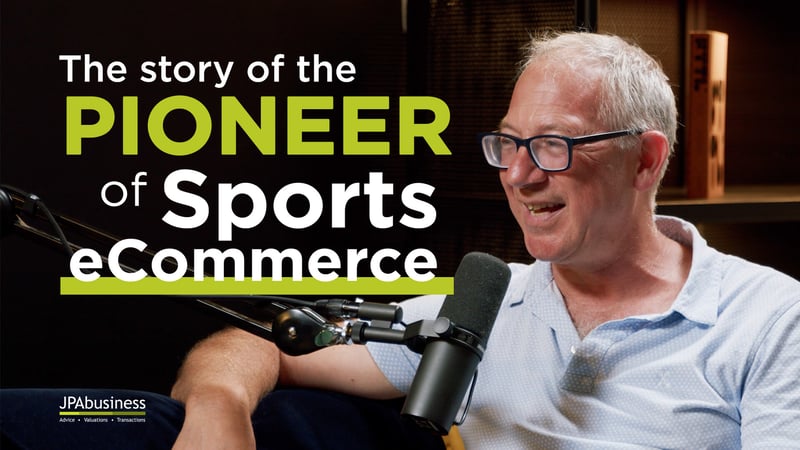
Most entrepreneurs dream of building a successful business. Far fewer build one that can grow without them, survive challenges and attract premium buyers.
Simon Millet achieved all three.
Across four decades, Simon built businesses spanning Olympic licensing, retail and e-commerce before selling one of Europe’s leading online sports retailers to JD Sports.
His journey demonstrates that valuable businesses are not created through revenue growth alone. They are built through strong relationships, scalable systems, great people and the discipline to create an organisation that does not depend on its founder.
The following lessons from Simon’s journey are relevant to any entrepreneur who wants to build a business with long-term value:
Key lessons from Simon Millet’s journey
-
Relationships create competitive advantage. Strong partnerships with suppliers, customers and employees create opportunities that contracts alone cannot.
-
True scale is about profitable growth. Increasing turnover only creates value when costs do not rise at the same pace.
-
Technology should simplify complexity. Systems, automation and data enable businesses to grow efficiently.
-
Build for the buyer before you plan to sell. Companies achieve higher valuations when they are not founder-dependent.
-
Invest in people early. Strong leaders allow founders to move from managing operations to leading strategy.
-
Transparency builds trust. Open communication creates confidence among suppliers, investors and acquirers.
-
Customer experience creates loyalty. Small moments of delight can become powerful competitive advantages.
Learning business from the ground up
Entrepreneurship surrounded Simon from an early age.
His father built successful manufacturing and retail businesses, while both grandfathers worked in retail and wholesaling. From age 12, Simon’s Saturdays were spent working in family stores, where he learned practical lessons about customers, stock management and margins.
Although he left school at 16 with few qualifications, those early experiences gave him something more valuable than formal education: commercial confidence.
He joined his father’s lighting manufacturing business in Manchester before later becoming a trainee at John Lewis department stores. Those experiences taught him how businesses operate from both an entrepreneurial and corporate perspective.
A handshake that created a £20 million business
Simon’s first major entrepreneurial opportunity began with a conversation rather than a business plan.
In 1982, his father attended a charity dinner and sat beside the Secretary of the British Olympic Association, who was looking for a licensing partner for merchandise connected to the 1984 Olympic Games.
By the end of the evening, they had agreed a partnership with nothing more than a handshake.
The next day, Simon’s father asked: “Do you fancy getting involved in the ’84 Olympics?”
At just 22, Simon became involved in managing Olympic merchandising rights throughout the UK through International Franchises.
The opportunity was exceptional. Global brands including Adidas, American Express and McDonald’s became customers.
However, Simon quickly learned that opportunity alone does not create success.
“The product was something everybody wanted, but we still had to build relationships.”
The business succeeded because it delivered for customers, worked closely with suppliers and earned the trust of major brands. Within three years, it had grown to around £20 million.
The lesson was clear: relationships are often the foundation beneath commercial success.
Opportunity favours preparation
The Olympic business later secured licensing rights for events including the 1986 Commonwealth Games in Edinburgh.
This attracted the attention of IMG, one of the world’s largest sports marketing organisations.
Simon was not actively looking to sell – the company was focused on delivering a successful event. However, IMG recognised strategic value beyond immediate financial performance.
The rights gave IMG access to opportunities it could not easily create itself.
The acquisition became Simon’s first successful exit and taught him an important lesson: businesses are often purchased for what they enable buyers to achieve, not just what they earn today.
Understanding strategic value is as important as understanding financial performance.
Growth is not the same as scalability
After selling the Olympic business, Simon returned to his father’s retail operation, which had around 30 stores across the UK.
He was only there about six months as the business was being sold, but it was still a valuable learning opportunity in several key areas, including scalability.
Many entrepreneurs confuse growth with scale, but adding more revenue does not automatically create more value. If every increase in sales requires a similar increase in people, premises and costs, the business becomes larger but not necessarily stronger.
As Simon explained: “If you’re going from one million to twenty million, you don’t want your overheads increasing at the same rate.”
He also saw the limitations of founder-led businesses. His father remained heavily involved in many decisions, and Simon realised that businesses become constrained when too much knowledge and authority sit with one person.
And, finally, he learned about buying and relationships.
“The most important lesson I learned was relationships, particularly as I was heading the buying department – how important those relationships were with the brands that he was dealing with. And that was something that really helped the next business I got involved in.”
Building Millet Sports
In 1987, Simon identified an opportunity in specialist sports retail.
A local sports retailer was closing as its owners retired. Rather than buying the existing store, Simon opened a larger premises nearby and launched Millet Sports.
The strategy was focused: become an expert retailer in premium sporting equipment across categories including running, football, rugby and tennis.
The response was immediate.
“From day one the store was extremely profitable.”
Success led to expansion, with stores opening across the country. However, Simon soon discovered a challenge familiar to many growing businesses.
Turnover increased, but profitability did not always follow. Each new store brought additional rent, staff, inventory and management requirements. Strong locations often supported weaker ones.
The experience reinforced a critical lesson: growth adds complexity. Scalability removes it.
Seeing the future of e-commerce
By the late 1990s, Simon had built a successful physical retail business but recognised its limitations. Every new store required more capital and increased fixed costs.
Then came the next opportunity.
In 2000, Millet Sports launched an online store. At the time, e-commerce was still emerging, but Simon saw its potential. A website could reach customers anywhere without requiring another physical location.
While some competitors questioned the investment, Simon saw a different opportunity. Digital advertising was affordable, competition was limited and customer behaviour was changing.
The business began shifting from a local retail model to a global digital platform.
Relationships remained the foundation
Although technology transformed the company, Simon never moved away from the principle that had driven his earlier success: relationships matter.
Millet Sports worked closely with major sporting brands and shared information openly with suppliers.
One important policy was paying suppliers quickly. While many retailers delayed payments, Millet Sports aimed to pay suppliers within seven days wherever possible.
The result was trust. When stock became limited, suppliers prioritised the company. When new products launched, brands wanted Millet Sports involved.
Simon also shared sales information with suppliers, helping them understand customer demand. Where others protected information, Simon used it to create collaboration.
The lesson: transparency can become a competitive advantage.
Technology creates leverage
By 2008, the online business had transformed Millet Sports. Revenue had grown from around £1.5 million in its early e-commerce years to approximately £10 million, with around 95% of sales generated online.
However, growth created a new challenge: operational complexity.
Simon’s son Anthony joined the business after working in wealth management and focused on improving scalability.
The company realised existing software could not support its ambitions, so it developed its own technology platform.
The system connected purchasing, inventory, customer data and operations. It helped monitor supplier stock levels, automate replenishment and improve decision-making.
Technology was no longer just an operational tool. It became a competitive advantage.
The company also built its own CRM system, storing detailed information on hundreds of thousands of customers. This enabled more targeted marketing, improved customer relationships and better decisions.
Today, these systems are common. At the time, they were a significant advantage.
Surviving difficult periods through trust
The Global Financial Crisis tested many businesses, including Millet Sports.
As retailers struggled and credit insurers reduced support, suppliers became more cautious.
Simon responded by relying on relationships built over many years. Together with the CEO, he visited suppliers personally, sharing financial information, plans and strategy.
The transparency created confidence.
One meeting with Asics demonstrated the power of trust. After hearing Simon’s plans, the chairman asked how much credit he needed.
Simon requested a significant amount. The chairman doubled it.
The decision was based not only on financial information, but on years of reliability and communication.
Simon’s lesson: Relationships built during good times determine how businesses survive difficult ones.
Building a business to sell
Unlike his first company, Simon built Millet Sports with an eventual exit in mind.
“When I saw the opportunity online, the intention was always to build the business and sell it.”
That ambition influenced every major decision. The company invested in technology, strengthened operations, recruited experienced leaders and reduced dependence on Simon.
Responsibility moved across the organisation. Anthony led operations. Simon’s brother supported finance. An experienced CEO helped drive growth and marketing.
Although the business was family-owned, Simon never wanted it to rely on the Millet family.
“I realised where my weaknesses were, and would bring in people who were much cleverer in that area.”
That mindset helped create a company buyers could trust. They were not buying a founder’s job. They were buying a functioning organisation.
Why JD Sports acquired Millet Sports
The eventual buyer was JD Sports.
The acquisition made strategic sense for both sides. Millet Sports had built a strong position in performance sports, while JD was traditionally stronger in sports fashion. The businesses served different but complementary markets.
JD also gained access to Millet Sports’ technology platform, customer base and expertise in online retail.
For Simon, finding the right partner mattered as much as achieving an exit.
The transaction included an earnout period, meaning Simon, Anthony and the management team remained involved after the acquisition.
The future value depended on continued growth, and the people who built the business were best placed to deliver it.
The foundations of a valuable business
Looking back, Simon believes several factors made Millet Sports attractive to buyers:
A strong team
The business invested in employee ownership through a share program, giving people a direct connection to success. This helped create loyalty, retention and alignment.
Valuable businesses are built by people who think like owners.
Reliable systems
By the time of the sale, major processes were supported by technology.
Finance, inventory, sales ordering and reporting systems provided accurate information quickly. Buyers could ask questions and receive answers within minutes.
Operational visibility created confidence.
Strong supplier relationships
Suppliers were among the most important references during the acquisition process.
Simon’s philosophy was simple: “You need your suppliers. They’re the people helping you with the product to build a business. Without them you don’t have a business.”
Those relationships were built through years of consistency, not created for the purpose of selling.
Customer experience as a competitive weapon
Millet Sports also understood that loyalty is often created through small details.
The company invested heavily in delivery systems, using technology to optimise speed, cost and reliability.
But one of its most memorable customer initiatives was surprisingly simple. After seeing Haribo at a trade show, Simon decided to include a small packet of sweets with every customer order.
The cost was minimal, but customers loved the gesture. People remembered it. They talked about it. It became part of the brand identity.
Eventually, the initiative became too expensive as the company scaled, but the lesson remained: small moments of customer delight can create lasting loyalty.
The final lesson: build beyond yourself
The strongest indicator of Millet Sports’ value was that it could operate without Simon. The company had capable leaders, reliable systems, strong relationships and a clear strategy.
For many founders, letting go is one of the hardest challenges. Simon experienced this himself: “I think it’s very hard to let go, as a business owner, but once you do that, you actually realise the ride is much easier.”
The reward was a business that buyers valued because it was not dependent on one person.
A business worth buying is not simply one that generates revenue. It is one built on strong foundations:
-
relationships that create opportunity
-
systems that enable scale
-
people who take ownership
-
technology that removes complexity
-
customers who trust the brand
-
leadership that continues beyond the founder.
That is the difference between building a business that works and building one that lasts.