
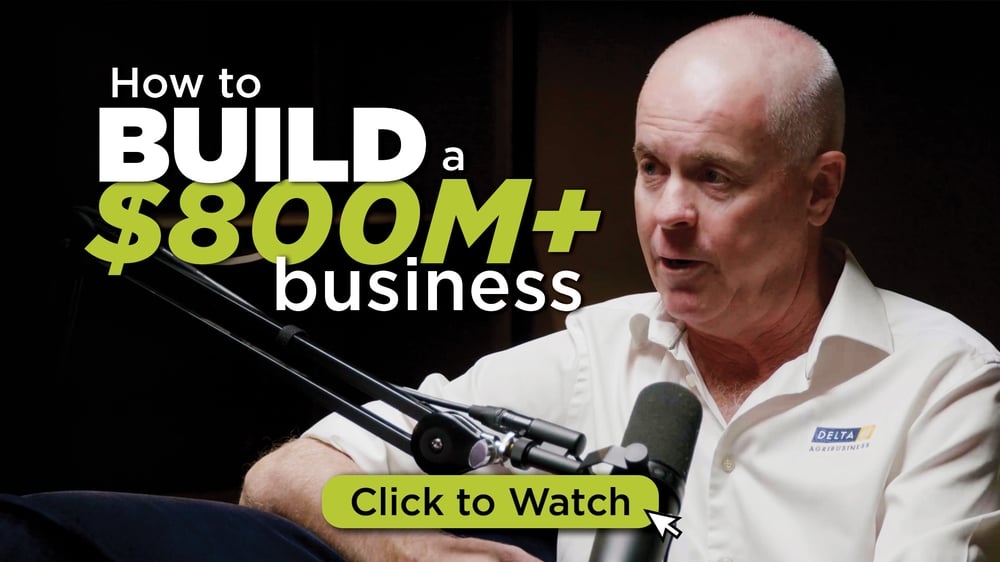
 I recently welcomed Delta Ag co-founder and managing director Gerard Hines to the Let’s Talk Business podcast.
Gerard oversaw the company’s recent $475 million sale to Elders, and shared some of the experiences and lessons that took him from 25% owner in a one-man retail business, to helming a national agribusiness with $850 million in revenue, 450 employees and 80 agronomists.
Based on our chat, here’s my take on 5 key contributors to Gerard’s success:
- Skin in the game creates accountability and long-term thinking
From being forced to buy 25% of a small business at age 23 to structuring Delta Ag’s equity model, Gerard consistently required owners and leaders to invest personally. This ensured commitment, careful decision-making and alignment between effort, risk and reward. - Compete on value, not price
Embedding qualified agronomists into retail was a radical move that shifted the business from price competition to trusted advisory services. By delivering independent, high-quality advice, Delta Ag built loyalty, pricing power and a durable competitive advantage. - Financial discipline beats aggressive growth
Gerard combined entrepreneurial drive with public-company discipline: strong balance sheets, zero debt at launch, rigorous systems, tight inventory control and daily margin reporting. This conservatism allowed Delta Ag to survive cycles, grow during downturns and profit from acquisitions without overextending. - Aligned ownership builds culture, loyalty and scalability
Delta Ag’s carefully designed equity model – limited entry, equal rules for all and equity used in acquisitions – created fairness, retained key people and protected goodwill. Vendors and employees became long-term partners, not short-term sellers or staff. - Trust people, stay close to the ground, and be patient
Gerard prioritised culture over structure, remained deeply engaged with customers and staff, and made decisive people decisions when needed. His patience, loyalty and common-sense leadership allowed Delta Ag to scale nationally without losing its core values.
In essence, Gerard’s success came from blending entrepreneurial instinct with discipline – aligning ownership, protecting culture, managing risk conservatively and relentlessly focusing on trust and value creation.
You can watch our podcast interview on YouTube or listen on your preferred podcast app.
I’ve also included a summarised version of our interview below.
Humble beginnings
Gerard’s journey to building one of Australia’s largest agribusiness service companies began with humble roots on a family farm in Wallendbeen, NSW.
Originally intending to remain a farmer, his path shifted in his early 20s when he accepted a role with a small fertiliser business. Despite being “shy and insecure” at the time, Gerard discovered a strong affinity for the competitive nature of agricultural retail and the challenge of finding commercial advantage.
A pivotal early experience came in 1987 when Gerard suffered severe burns while fighting a bushfire, delaying his return to farming and ultimately redirecting his career. Soon after, he was approached by ag wholesaler and family friend Brian O’Malley, who encouraged him to manage a small rural retail business – but only on the condition that Gerard invested personally.
At just 23, Gerard was required to purchase 25% equity, funded through a bank loan personally guaranteed by Brian. This early insistence on “skin in the game” became a defining principle in Gerard’s later leadership philosophy, reinforcing accountability, commitment and long-term thinking.
Adding value
Gerard transformed the business by introducing something radical at the time: a qualified agronomist embedded within a retail operation. This shift moved the business away from competing purely on price and toward value-based advisory services.
Farmers quickly recognised the quality and independence of the advice, and demand grew to the point where clients were willing to pay for access. This laid the foundation for a consulting model that would become central to the business’s success.
Through ownership changes and industry consolidation in the 1990s and early 2000s, Gerard gained invaluable exposure to public company governance, particularly through partnerships with Wesfarmers.
While witnessing the failures of poorly integrated public agribusiness models, he also absorbed critical lessons around back-end discipline – systems and processes, stock control, cash flow management and balance-sheet strength – areas often neglected by entrepreneurial businesses focused solely on growth.
Going it alone
In 2006, concerned about cultural misalignment, loss of key staff and limited growth potential within a corporate structure, Gerard and his partners made a decisive move. They left to establish Delta Ag from scratch.
Fifteen staff followed immediately, with eight becoming shareholders by mortgaging their homes. This inclusive ownership model – offering equity to key contributors – became central to Delta Ag’s culture, driving care, accountability and long-term loyalty.
One of the most deliberate strategic decisions was launching the business with a strong balance sheet and zero debt. Drawing on past experience, Gerard believed leverage was particularly dangerous in agriculture due to its cyclical nature.
Financial strength allowed Delta Ag to survive droughts, secure supply, invest ahead of market movements and grow during downturns when competitors were constrained.
Over nearly two decades, Delta Ag expanded from two branches to more than 60 locations through a disciplined mix of acquisitions and greenfield sites. Growth was selective, supported by a formal board, clear governance, and a strict separation between employment and shareholding.
Gerard emphasised that dilution, when done for the right reasons, strengthens a business by building capital, retaining talent and reinforcing shared responsibility.
Ultimately, Gerard’s story is one of patience, discipline and trust in people – proving that strong culture, financial conservatism and aligned ownership can create enduring value in even the most competitive industries.
Delta Ag's equity model
In the second half of the interview, Gerard expanded on the structural and cultural mechanisms that allowed Delta Ag to scale while preserving alignment, discipline, and trust. A central theme was the company’s equity model, which applied equally to employees and acquisition partners.
Staff could only buy shares once, after 12 months of service, during a limited annual window. This forced a deliberate commitment decision and prevented wealthier individuals from accumulating control over time.
Equity growth thereafter came only through dividend reinvestment or buying shares from exiting shareholders, creating fairness and long-term alignment.
This same equity philosophy became a powerful acquisition tool. In most of Delta Ag’s 23 acquisitions, vendors received roughly 50% cash and 50% equity, priced consistently using the company’s dividend reinvestment plan valuation. This shifted negotiations away from headline price and toward long-term value creation.
In several cases, the equity component alone became worth more than the entire original business within a few years. Just as importantly, vendor equity ensured continuity of leadership, retention of key people, protection of goodwill and confidence for customers who continued dealing with familiar faces.
Delta Ag’s scale at the time of sale was approximately $850 million in revenue, 450 employees and 80 agronomists, with advisory services forming the core of its value proposition.
Consulting was tightly integrated with product supply; Delta Ag deliberately rejected a standalone advisory model, arguing that advisory alone could not be priced sustainably. Instead, trust, loyalty and long-term relationships drove profitability in a highly competitive agribusiness market where people costs were intentionally higher than industry norms.
Partnering with private equity
A major strategic inflection point came in 2019, when Delta Ag brought in Odyssey Private Equity as a minority shareholder.
This decision was driven by three factors: the need for geographic diversification after severe drought in NSW, the growing challenge of providing liquidity to retiring shareholders in a private company, and the desire to fund acquisitions without taking on debt.
Odyssey acquired an initial 15% stake by buying shares from existing shareholders and later provided committed equity capital for acquisitions. Crucially, they were selected for being hands-off operationally, supportive of culture and aligned with long-term growth rather than short-term cost cutting.
Although the original intention was not to sell the whole business, the eventual sale to Elders emerged as the most logical outcome. Overseas buyers struggled with Australia’s cyclical agricultural risk, while Elders understood the industry deeply and saw Delta Ag as a strategic complement to its agency-led strengths.
The transaction preserved Delta Ag’s independence: the brand, culture, leadership team and board structure remained intact, with Elders providing scale, procurement power and backend support rather than integration.
Lessons from public companies
Gerard emphasised that Delta Ag’s operational excellence came from public company-level systems: daily margin reporting, rigorous inventory controls, continuous stocktakes, disciplined rebate reconciliation and unified systems across branches. These practices often doubled profits post-acquisition without revenue growth by eliminating leakage and inefficiency.
Culturally, Delta Ag avoided branch-level profit sharing to prevent silos, instead rewarding collective value creation. Performance management focused on continuous daily feedback, separating remuneration from formal reviews. Founders remained deeply engaged with customers and staff, believing proximity to the ground was essential to leadership.
Reflecting on the journey, Gerard identified trust, loyalty, common sense and decisive people management as the enduring foundations of Delta Ag’s success – and the true source of its long-term value.
For more great interviews with business leaders, watch or listen to our Let’s Talk Business podcast on YouTube or your preferred podcast app.